 Skip-the-line available
 What to See Inside the Alcázar de Segovia
The Hall of the Galley, the throne room, the armoury museum and the Tower of Juan II — what to prioritise and why.
From outside, the Alcázar de Segovia is all silhouette — the prow, the spires, the drop to the ravine. Inside, it is a sequence of compact, richly decorated royal rooms, a museum of arms and artillery history, and one of the best tower climbs in Spain. This guide walks the circuit in order, so you know where to slow down, what the ceilings are telling you, and whether the 152 steps at the end deserve your remaining energy (they do).
The State Rooms and the Hall of the Galley
The palace circuit is one-way and begins in the rooms that made this a favourite residence of Castile's monarchs. The celebrated space is the Hall of the Galley, named for its magnificent coffered ceiling shaped like an inverted ship's hull — an upturned galley floating above the room, in a castle already shaped like a ship. Around it the circuit threads throne rooms and royal chambers dense with Mudéjar-influenced ornament, gilded friezes, heraldry and stained glass, evoking the court world in which Isabella sheltered here in December 1474 before her proclamation as Queen of Castile.
Look up in every room: after a fire in 1862 destroyed many of the original sumptuous ceilings, the interiors were painstakingly restored, and the ceilings remain the consistent glory of the visit — each room's character set by the geometry overhead. The rooms themselves are intimate rather than vast, which is part of the castle's charm; this was a fortress-palace on a narrow rock, not a sprawling court complex, and the visit moves at a natural pace of about an hour through the state rooms. The windows offer constant, vertiginous views into the green ravines below — free previews of what the tower delivers in full.
The Armoury Museum and the Artillery Centuries
The castle's museum rooms hold a collection of arms and armour that reliably stops children and military-history enthusiasts in their tracks — edged weapons, firearms, armour and artillery pieces spanning the castle's long martial history. They also tell the castle's least-known story: in 1764 the Alcázar de Segovia became the Royal College of Artillery, one of Europe's foremost military academies, and it served that role for a century. The displays on the college era explain why a medieval royal castle feels, in places, like a faculty — because for generations of artillery cadets, it was one.
Part of the building still houses the General Military Archive of Segovia, one of Spain's principal military archives — not on the visitor circuit, but a reminder that this castle never became a mere monument. Allow 20–30 minutes for the museum rooms after the state apartments; they are compact and well laid out. Together with the palace circuit, the interior takes 1 to 1.5 hours at an unhurried pace, which leaves exactly the right amount of energy for the decision waiting at the end: the staircase door of the Tower of Juan II.
The Tower of Juan II — Finish at the Top
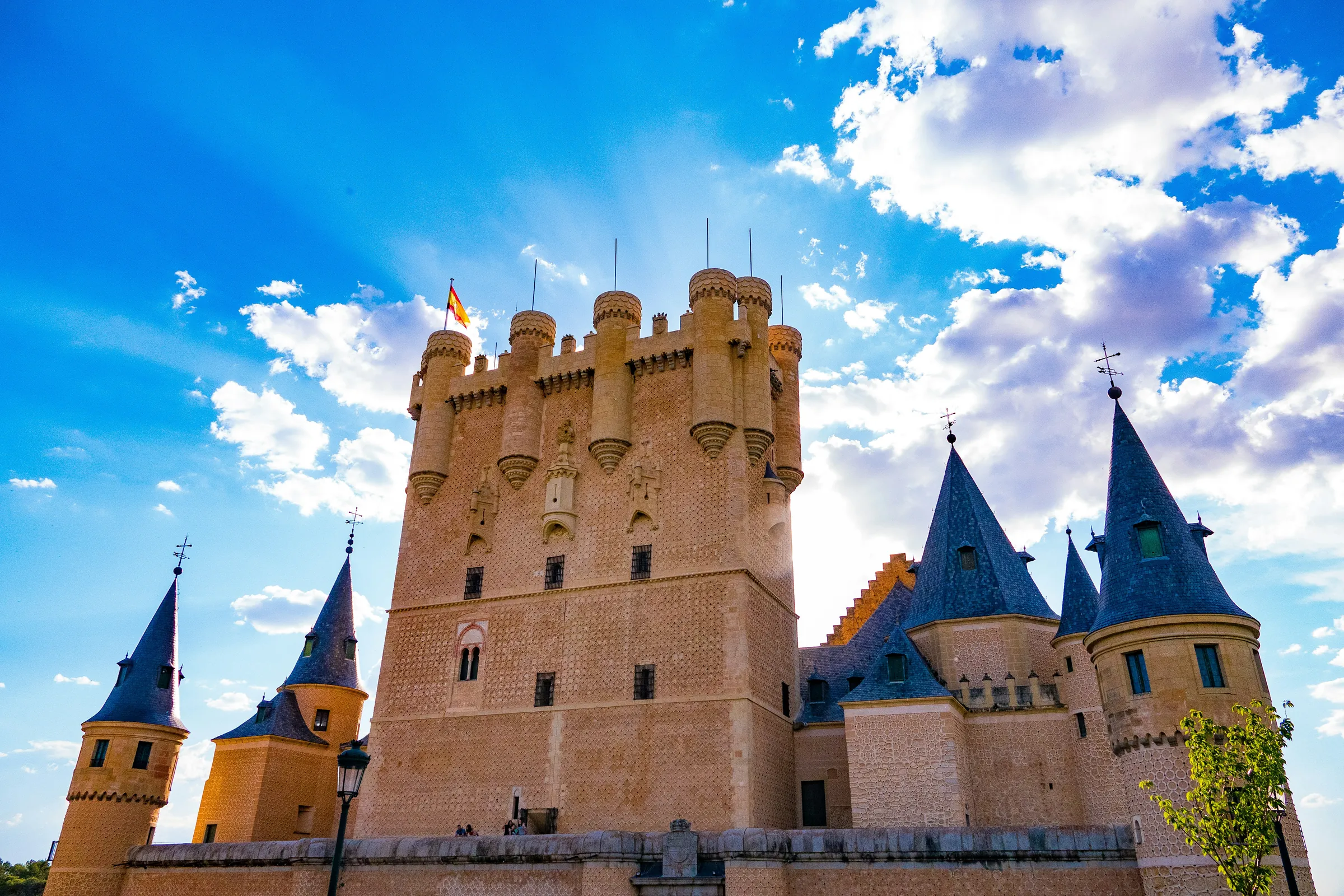
If you booked the Complete ticket, the visit ends — or peaks — with the Tower of Juan II, the massive 15th-century tower above the entrance. The climb is a tight spiral of 152 steps, medieval in every sense: steep, narrow, atmospheric, with the occasional arrow-slit glimpse of the drop outside. There is no lift and no halfway exit, so commit when you feel fresh enough; the climb takes most visitors five to ten minutes with pauses. The staircase admits limited numbers, which is why tower capacity sells out ahead of palace entry.
The terrace at the top justifies every step. The panorama runs the full circle: Segovia's cathedral lifting over the rooftops of the old town, the line of the Roman aqueduct beyond, the Sierra de Guadarrama walling the southern horizon, and directly below, the ravines of the Eresma and Clamores wrapping the castle's prow — the view that explains why a fortress stands here at all. Late afternoon gives the warmest light; early morning the clearest air. Photographers should bring a wide lens for the roofscape of spires at terrace level, the same slate cones that found their way into Disney's fairy tales.
Frequently asked
What is the must-see room inside?
The Hall of the Galley, with its coffered ceiling shaped like an inverted ship's hull. Around it, the throne room and royal chambers — with their restored Mudéjar-influenced ceilings, friezes and stained glass — form the heart of the palace circuit.
How long does the interior take?
About 1 to 1.5 hours for the state rooms and the armoury museum, plus roughly 30 minutes for the Tower of Juan II climb and terrace if you hold the Complete ticket.
Are the interiors original?
The castle is medieval, but a fire in 1862 destroyed many original ceilings; what you see today is a careful 19th-century restoration evoking the castle's royal centuries. The architecture, setting and many collections are original — and the restoration is itself part of the castle's story.
What's in the museum?
Arms, armour and artillery collections, plus the story of the Royal College of Artillery, the military academy founded in the castle in 1764. It's compact — 20–30 minutes — and a reliable hit with children.
Is the tower climb worth it?
If you can manage 152 steep spiral steps, emphatically yes — the 360° panorama over the cathedral, old town, aqueduct line and sierra is the best view in Segovia. If stairs are a concern, the palace windows offer fine valley views without the climb.
Can I take photographs inside?
Yes, for personal use without flash or tripod. The ceilings reward a wide angle; the tower terrace and the palace windows give the best exterior shots from within the castle.
Where did Isabella's proclamation happen?
Isabella took refuge in this castle when Henry IV's death was announced and was proclaimed Queen of Castile in Segovia on 13 December 1474. The state rooms evoke the court world of that moment — the pivot from which the unification of Spain followed.